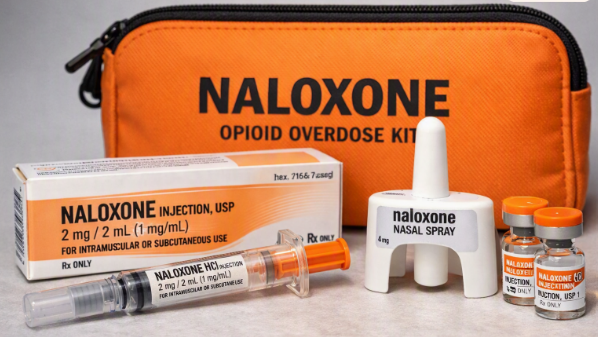
Opioid Safety & Naloxone
Opioid Safety and Naloxone
A fully self-directed, entirely online professional development programme. 7.5 CPD hours. Eleven modules. For registered and enrolled nurses, nurse practitioners and midwives in every setting where an opioid is given - and for the managers and educators who own the observation chart, the escalation trigger and the naloxone protocol.
The line this course holds
In any patient given an opioid, oversedation should be considered to indicate OIVI until proven otherwise - regardless of respiratory rate or oxygen saturation.
Opioid-induced ventilatory impairment has three components: central respiratory depression, sedation, and upper airway obstruction. Only one of them can be assessed at the bedside by anybody, with no equipment, in about ten seconds - and it is the one that correlates best with arterial carbon dioxide.
Why the observations mislead
Respiratory rate is a very unreliable measure: some patients maintain a rate within acceptable limits even in the presence of SEVERE OIVI, and a rate counts breaths without measuring depth. Oxygen saturation may remain acceptable while arterial carbon dioxide rises, because it is an oxygenation measure rather than a ventilation measure - and supplemental oxygen makes it weaker still.
Which settles what this course is about: assess the sedation, every time, in every patient given an opioid - and act on a score of 2, which is early OIVI.
One set of numbers in, every other number out
- The sedation score is carried exactly as published. 0 wide awake, 1 easy to rouse, 2 easy to rouse but unable to remain awake, 3 difficult to rouse - and the aim is always less than 2. Using a different scale is itself the hazard, which is why a scale containing 'S' for normally asleep is recommended against
- And there is no opioid dose, no conversion value and no naloxone regimen anywhere in it. Those belong to a prescriber, a pharmacist and your service's locally approved protocol. Completing this course authorises nothing beyond your existing scope
What you will be able to do
- State the governing principle, and name the three components of OIVI
- Use the sedation score 0 to 3 correctly, and explain why 2 is the trigger rather than 3
- Explain why a scale containing an S should not be used, and why AVPU cannot do this job
- State when a sedation score is taken, including at the expected peak effect, and why it is monitored AND documented
- Explain why respiratory rate and oxygen saturation mislead, and what the commonly taught thresholds are worth
- State why all patients given an opioid must be assumed to be at risk
- Identify the named modifiable risks, including inadequate nursing assessments or responses and chasing pain scores
- Withhold, rouse and escalate at a sedation score of 2 - and give a smaller dose if more analgesia is needed, regardless of pain score
- Describe what naloxone does and does not do, and why re-sedation is the expected risk
- Conduct the take home naloxone and discharge conversation the standard requires
Sources, retrieved 19/09/2026. Stewardship: ACSQHC Opioid Analgesic Stewardship in Acute Pain Clinical Care Standard, 2022 - nine quality statements, of which quality statement 6 is the nurse's, with indicator 6a measuring a system rather than a nurse. Sedation score and the OIVI statement: ANZCA and FPM PS41(G) Acute pain management, 2023, Appendix 1 - the stand-alone OIVI statement has been INCORPORATED INTO PS41(G), which is why it cannot be found separately. Take home naloxone: the Australian Government Take Home Naloxone program, national and free without prescription since 1 July 2022; naloxone has been a Pharmacist Only medicine for the treatment of opioid overdose since 2016. Regulatory reform: Therapeutic Goods Administration prescription opioid reforms. NOT stated in this course, because they belong to a prescriber, a pharmacist, a local protocol or a state: any opioid dose, strength, frequency, infusion rate or duration; any equianalgesic or conversion value; any naloxone dose, interval or titration regimen; any opioid tapering regimen; and any Schedule 8 storage, register or witnessing requirement. Review due 19/09/2027.
| जिम्मेदार | Sandra Thorp |
|---|---|
| Last Update | शनिवार 19 सित॰ 2026 |
| Completion Time | 1 दिन 5 घंटे 20 मिनट |
| Members | 1 |
-
-
प्रीव्यू नया
-
प्रीव्यू नया
-
-
Module 00 - Orientation: Why Sedation Is the Sign3Lessons · 1 घं॰ 42 मि॰
The line the whole programme rests on: in any patient given an opioid, oversedation should be considered to indicate OIVI until proven otherwise - regardless of respiratory rate or oxygen saturation.
Then what the course is for. Opioid-induced ventilatory impairment is the harm; the sedation score is the assessment that detects it; and the whole thing needs no equipment and takes about ten seconds. Everything else in the programme is a consequence of those three sentences.
And what this course deliberately does not carry: no opioid dose, no conversion value and no naloxone regimen, ever. Those belong to a prescriber, a pharmacist and your service's locally approved protocol. The one set of numbers it does carry - the sedation score - is carried exactly as published, because using a different scale is itself the hazard.
Plus the ten local questions it leaves for you to answer at your own workplace, starting with the one almost nobody can answer: what scale is printed on your observation chart?
In this section: the module slide deck, the student learner guide, and the knowledge check. The check is formative - not graded, no attempt limit - and the rationale on every option is the content.
-
Module 00 - Orientation (slide deck)नया
-
Module 00 - Student learner guideनया
-
Module 00 - Knowledge checkनया
-
-
Module 01 - OIVI: What Opioids Do to Breathing3Lessons · 1 घं॰ 31 मि॰
Three components, not one. Central respiratory depression - a reduction in alveolar ventilation, which is rate AND depth, and depth is the half no observation chart records. Sedation - depression of consciousness, and the only component assessable at the bedside by anybody with no equipment. And upper airway obstruction, which is why snoring matters.
Alone or together they reduce alveolar ventilation and raise arterial carbon dioxide - which is why the term is opioid-induced ventilatory IMPAIRMENT rather than respiratory depression. 'Respiratory depression' names only the first of the three, and it is the one the observation chart measures worst.
And the sentence to take to the bedside tonight: a snoring patient who has been given an opioid is not assumed to be sleeping normally. Snoring may be partial upper airway obstruction, it has been reported before harm, and it is the sign most often dismissed by the people in the room.
In this section: the module slide deck, the student learner guide, and the knowledge check. The check is formative - not graded, no attempt limit - and the rationale on every option is the content.
-
Module 01 - OIVI (slide deck)नया
-
Module 01 - Student learner guideनया
-
Module 01 - Knowledge checkनया
-
-
Module 02 - The Sedation Score, and the Scale Not to Use3Lessons · 1 घं॰ 38 मि॰
The instrument itself, reproduced exactly: 0 wide awake. 1 easy to rouse. 2 easy to rouse but unable to remain awake. 3 difficult to rouse.
A score of 2 indicates EARLY OIVI - not a comfortable patient and not a bad night's sleep - and the aim is to titrate an opioid so that the score is always less than 2. Note that 2 is the trigger rather than 3: waiting for 'difficult to rouse' means waiting until the compensation has failed.
Then the scale not to use. A sedation scale containing 'S' for normally asleep is recommended against, because a patient recorded as S may never be woken properly, so their sedation is never actually assessed. If your chart has an S on it, that is a finding to take to your educator. AVPU cannot do this job either - it cannot separate a patient who is easy to rouse and stays awake from one who is easy to rouse and cannot.
And when to score: at administration, and again at the expected peak effect - about an hour for an immediate-release PRN opioid given orally or subcutaneously. Monitored AND documented.
In this section: the module slide deck, the student learner guide, and the knowledge check. The check is formative - not graded, no attempt limit - and the rationale on every option is the content.
-
Module 02 - The sedation score (slide deck)नया
-
Module 02 - Student learner guideनया
-
Module 02 - Knowledge checkनया
-
-
Module 03 - Why Respiratory Rate and Saturation Mislead3Lessons · 1 घं॰ 32 मि॰
The module that makes the governing statement usable. Respiratory rate is a very unreliable measure - some patients maintain a rate within acceptable limits even in the presence of SEVERE OIVI. A rate counts breaths; it does not measure how much air moves in each one, and alveolar ventilation is the product of both.
Oxygen saturation may stay within range while arterial carbon dioxide rises, because saturation is an oxygenation measure rather than a ventilation measure - and supplemental oxygen makes it weaker still. Intermittent pulse oximetry misses the worst of it, because hypoxaemia is commonly worse while the patient is asleep and taking the measurement rouses them.
The course carries the commonly taught thresholds - 8 or 10 breaths per minute - for one reason only: so that you recognise the numbers you were taught, and know what they are worth. Sedation correlates better with arterial carbon dioxide than either measure, which is the argument for the whole programme.
In this section: the module slide deck, the student learner guide, and the knowledge check. The check is formative - not graded, no attempt limit - and the rationale on every option is the content.
-
Module 03 - The misleading numbers (slide deck)नया
-
Module 03 - Student learner guideनया
-
Module 03 - Knowledge checkनया
-
-
Module 04 - Who Is at Risk - and Why Everybody Is3Lessons · 1 घं॰ 26 मि॰
The patient risk factors: older age, sleep-disordered breathing, obesity, renal impairment, pulmonary disease, cardiac disease, two or more comorbidities, genetic variation in opioid metabolism, and opioid tolerance. Plus the finding most people have not heard - a significant proportion of patients WITHOUT sleep-disordered breathing before surgery develop it afterwards on opioids.
And then the two things that matter more than the list. These are reported associations only and cannot show causation. And - the sentence this module is built on - many patients who come to harm have no identifiable comorbidities that would predict increased risk.
Which is why all patients must be assumed to be at risk. The risk list tells you where to look harder. It does not tell you who to stop looking at, and a list of associations used as a screening tool produces false reassurance in exactly the patients this course is about.
In this section: the module slide deck, the student learner guide, and the knowledge check. The check is formative - not graded, no attempt limit - and the rationale on every option is the content.
-
Module 04 - Risk (slide deck)नया
-
Module 04 - Student learner guideनया
-
Module 04 - Knowledge checkनया
-
-
Module 05 - The Modifiable Risks That Are Nursing Practice3Lessons · 1 घं॰ 32 मि॰
The other list, and this one can be changed. Co-administration of sedatives - benzodiazepines, gabapentinoids, antipsychotics, sedating antihistamines - which is the most common factor and the one most easily missed on a drug chart read quickly. Multiple opioid agents. Continuous infusions. Initiation of long-acting preparations. Multiple prescribers.
And two that are nursing practice itself. 'Inadequate nursing assessments or responses' is a named modifiable risk factor, in those words - which makes it the most hopeful item on the list and the reason this course exists. And 'chasing' pain scores: titrating an opioid to a unidimensional pain score alone, to bring it down to a predetermined number that is usually somebody's habit rather than anybody's clinical decision.
Plus the worst trade in the subject - more opioid for pain that never responded to the first dose, which produces sedation without analgesia.
In this section: the module slide deck, the student learner guide, and the knowledge check. The check is formative - not graded, no attempt limit - and the rationale on every option is the content.
-
Module 05 - Modifiable risks (slide deck)नया
-
Module 05 - Student learner guideनया
-
Module 05 - Knowledge checkनया
-
-
Module 06 - When Sedation Reaches 23Lessons · 1 घं॰ 33 मि॰
The action module, and the one the whole programme is arranged around. At a sedation score of 2: withhold ALL opioids until the patient is awake - withhold, not delay - rouse properly, and escalate according to your local protocol.
Then the conflict the bedside actually feels. The patient is in pain and the next dose is due. The Clinical Care Standard settles it plainly: if more analgesia is needed, a SMALLER dose should be given - regardless of pain score. The pain score does not overrule the sedation score.
And the failure this module exists to prevent: not escalating, or escalating late, which is the commonest failure described in published reports of opioid-related harm. The point of a track-and-trigger system is that you do not have to decide alone at 3am. Plus what else to look for, and what goes in the notes.
In this section: the module slide deck, the student learner guide, and the knowledge check. The check is formative - not graded, no attempt limit - and the rationale on every option is the content.
-
Module 06 - The response (slide deck)नया
-
Module 06 - Student learner guideनया
-
Module 06 - Knowledge checkनया
-
-
Module 07 - Naloxone: What It Does and Does Not Do3Lessons · 1 घं॰ 32 मि॰
Naloxone temporarily reverses the effects of an opioid by blocking opioids from attaching to opioid receptors. Temporarily is the word that carries the module: it lasts about 30 to 90 minutes, and most opioids last longer.
This course gives you no naloxone regimen, and that is deliberate. The Clinical Care Standard's own wording is to consider administration to reverse respiratory depression according to a locally approved protocol, and the community product is supplied with instructions written for a person with no training. Both of those beat a course, and a remembered number displaces both.
What it does not do: it does nothing for a non-opioid cause, it is not a routine correction for a sedation score of 2, and it does not end the episode. Plus who may administer it - anyone in the community following the packaging instructions; in a health service, whoever your locally approved protocol or standing order says.
In this section: the module slide deck, the student learner guide, and the knowledge check. The check is formative - not graded, no attempt limit - and the rationale on every option is the content.
-
Module 07 - Naloxone (slide deck)नया
-
Module 07 - Student learner guideनया
-
Module 07 - Knowledge checkनया
-
-
Module 08 - After Naloxone: Re-sedation and Withdrawal3Lessons · 1 घं॰ 41 मि॰
Most of what matters happens after the naloxone. Re-sedation is the expected risk, not the surprise - so the patient who is awake, apologetic and asking to go back to sleep is not finished, they are inside a window. Modified-release preparations, patches and infusions extend it considerably, and a patch keeps releasing drug while everybody stands around the bed.
Reversal in an opioid-tolerant person can precipitate severe withdrawal - sweating, agitation, vomiting, cramping and real distress, arriving in seconds. The principle that resolves it is to titrate to adequate breathing rather than to full consciousness. And none of it is a reason to withhold naloxone from somebody who is not ventilating: the choice is never between withdrawal and comfort, it is between withdrawal and not breathing.
Then the three problems a reversal creates, the review of what got the patient there - and the part almost every opioid course leaves out: the nurse who found them, and what she needs this week and again next week.
In this section: the module slide deck, the student learner guide, and the knowledge check. The check is formative - not graded, no attempt limit - and the rationale on every option is the content.
-
Module 08 - After naloxone (slide deck)नया
-
Module 08 - Student learner guideनया
-
Module 08 - Knowledge checkनया
-
-
Module 09 - Take Home Naloxone and the Discharge Conversation3Lessons · 1 घं॰ 36 मि॰
Since 1 July 2022, naloxone has been free and available without a prescription to anyone who may experience OR WITNESS an opioid overdose - which explicitly includes carers, friends and family members. A person who will never use it themselves may be exactly the right person to hold it.
And the reversal of intuition most nurses have not heard: the highest-risk moment is when tolerance has dropped, not when the dose is highest. After treatment, after an admission, after release from prison - which is exactly the moment a nurse is standing there discharging somebody.
Then the signs of overdose in the words you would say to a family member, why an ambulance is called every time, and the discharge conversation the Clinical Care Standard actually requires - adverse effects and the signs of overdose, safe storage and safe disposal, and written information to take home. Plus a sentence for offering naloxone without it sounding like an accusation.
In this section: the module slide deck, the student learner guide, and the knowledge check. The check is formative - not graded, no attempt limit - and the rationale on every option is the content.
-
Module 09 - Take home naloxone (slide deck)नया
-
Module 09 - Student learner guideनया
-
Module 09 - Knowledge checkनया
-
-
Module 10 - Opioid Stewardship: the Standard Around All of It3Lessons · 1 घं॰ 51 मि॰
The frame the whole course has been sitting inside: the ACSQHC Opioid Analgesic Stewardship in Acute Pain Clinical Care Standard (2022) and its nine quality statements.
Quality statement 6 is the nurse's. It requires that adverse effects are monitored and managed, that sedation levels are monitored AND documented, that the patient and carer are made aware of adverse effects and signs of overdose including respiratory depression, and that naloxone is considered according to a locally approved protocol. Every module in this course is one clause of that statement, worked out at the bedside.
Its indicator 6a - the proportion of admitted patients given opioids who were administered naloxone for respiratory depression - is a measure of a system, not of a nurse. A ward that treats it as a nursing failure gets fewer reversals RECORDED rather than fewer reversals.
Plus the TGA regulatory reforms, the scope boundary across five roles, and the ten local questions this course cannot answer for you.
In this section: the module slide deck, the student learner guide, and the knowledge check. The check is formative - not graded, no attempt limit - and the rationale on every option is the content.
-
Module 10 - Stewardship (slide deck)नया
-
Module 10 - Student learner guideनया
-
Module 10 - Knowledge checkनया
-
-
Assessment5Lessons · 3 घं॰ 40 मि॰
Three pieces. The assessment brief explains how the assessment is built and what the mandatory-correct items are. The case study assessment is five unfolding situations across 25 branching decisions - completion required, not graded, and every option carries feedback including the plausible wrong ones. The summative assessment is 60 single-best-answer items blueprinted across all eleven modules, 80 per cent to pass, two attempts, and a pass issues the certificate automatically.
Twenty of the items are mandatory-correct: a wrong answer sends you back to that module whatever your overall score. The three in Module 02 and the two in Module 03 matter most, because a learner who leaves believing that an acceptable respiratory rate or saturation excludes OIVI - or who scores sedation on a scale containing an S - has been made more dangerous by the training. The pair in Module 06 is next, because knowing what a 2 means and not withholding and escalating is knowledge without action.
No keyed answer supplies an opioid dose, a conversion value or a naloxone regimen - a units allow-list in the item bank enforces that automatically. And nothing local is assessed as though it were national.
-
Assessment brief - read before you startनया
-
Case study assessment (printable)नया
-
Summative assessment (printable paper)नया
-
Case Study Assessment (interactive)नया
-
Summative Assessment - 60 items, 80% to passनया
-
-
Practice Tools (optional)5Lessons · 1 घं॰ 20 मि॰
Five optional interactive tools. Score the sedation - fourteen patients, and most of them are 0s and 1s, because scoring is routine rather than an emergency activity. Reassuring or not? - fourteen findings, several of which genuinely are, including all four classic errors: a normal rate, a normal saturation, a saturation on oxygen, and a snoring patient. What do you do now? - twelve situations where the answer at a 2 never changes, with 'give it a bit later' present because it is the actual error. Naloxone: true or not? - fourteen statements, two of which are questions only your own ward can answer. And the opioid safety self-check, where almost every row reads the same for every role, because a sedation score needs no equipment, no seniority and no authorisation.
Optional, and excluded from the claimable CPD figure. If you complete them you may claim the time separately as self-directed CPD. Nothing you type or choose in any of them leaves your own browser.
-
Score the Sedationनया
-
Reassuring or Not?नया
-
What Do You Do Now?नया
-
Naloxone: True or Not?नया
-
Opioid Safety Self-Checkनया
-
-
Workplace Tools3Lessons · 1 घं॰ 30 मि॰
Three fillable instruments for use at work rather than for reading. The sedation monitoring audit examines the chart, the protocol and twenty de-identified records - it is an audit of conditions, not of people, and its first question is what scale is printed on your observation chart. The OIVI response walk-through is a rehearsal done at the bed space, recording how long it takes to find the naloxone, the protocol and the escalation number. The take home naloxone conversation guide is the ninety seconds at discharge the standard requires - the signs of overdose in a family member's words, who else is in the house, and safe storage and disposal.
All three are PDFs you can type into and save. They credential nobody, none of them supplies a dose, and every drug decision in them routes to your locally approved protocol and the product instructions.
-
Sedation monitoring audit (fillable) - your chart, your protocol, your last twenty patientsनया
-
OIVI response walk-through (fillable) - rehearse it before 0300 rehearses youनया
-
Take home naloxone conversation guide (fillable) - the ninety seconds at dischargeनया
-
-
Reference3Lessons · 3 घं॰ 45 मि॰
The reflective workbook - fillable, and your CPD evidence, which the NMBA expects you to hold. It carries a page for the ten local answers this course deliberately does not supply, the sedation rules written out in your own words, the modifiable risks read honestly against your own ward, and sentence practice for the things that are hardest to say at 3am. The scope of practice card is one page to print and keep: the sedation score, when to score, what to do at a 2, why the observations mislead, naloxone, the signs of overdose, the discharge conversation, and the never list. And the further reading directory lists the Australian sources with live links - including why the stand-alone ANZCA OIVI statement cannot be found separately any more.
-
Student reflective workbook (fillable) - your CPD evidenceनया
-
Student scope of practice card - print thisनया
-
Further reading and organisation directoryनया
-