Life in Australia.
What to expect when you come to Australia to work as a nurse or midwife, and the practical things to arrange in your first weeks.

Nursing and midwifery in Australia
Nurses and midwives work in public and private hospitals, residential aged care, community and primary health, mental health, disability services, and in regional and remote areas where they often carry broad responsibility.
To work as a nurse or midwife you must be registered with the Nursing and Midwifery Board of Australia (NMBA). You apply through Ahpra. Registration and a visa are separate: registration does not give you the right to work in Australia, and a visa does not register you.
Where OBA fits
OBA Nursing Academy prepares you for the registration exams and for the Australian workplace. The NMBA decides registration. OBA does not deliver a nursing qualification.
Your first weeks
Bank account
Open an Australian bank account early. Your employer pays your salary into it.
Tax file number
Apply to the Australian Taxation Office for a tax file number and give it to your employer.
Superannuation
Employers pay retirement savings, called superannuation, into a fund on top of your pay. You can choose the fund.
Health cover
Whether you can use Medicare depends on your visa. Check the conditions of your visa, as some require you to hold private health insurance.
Housing
Most people rent through a real estate agent or share a house. Expect to pay a bond and rent in advance, and to show identification and proof of income.
Phone and transport
A local mobile number makes job applications and rosters easier. Check how you will travel to shifts that start early or finish late.
How pay works
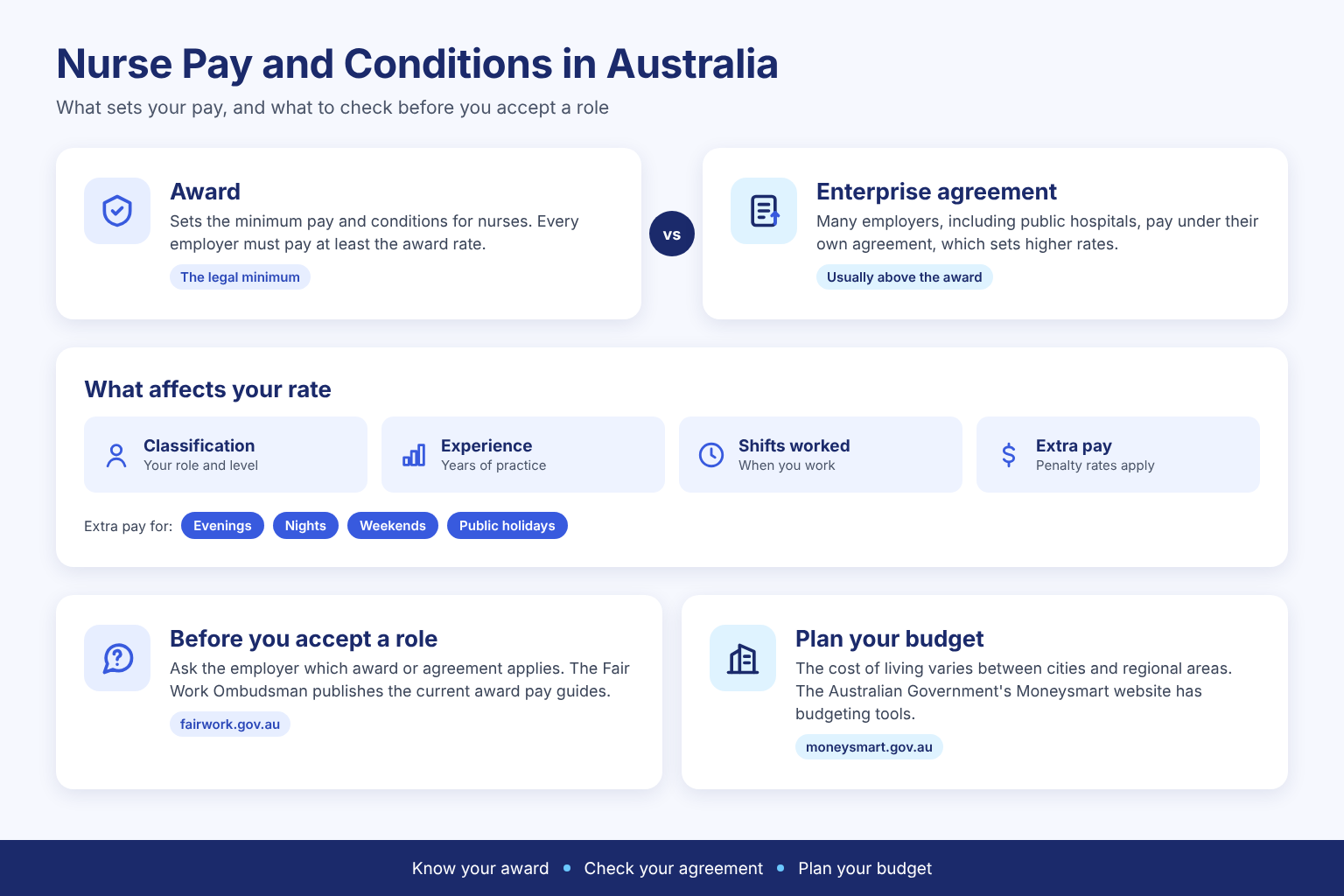
Minimum pay and conditions for nurses are set by an award. Many employers, including public hospitals, pay under their own enterprise agreement, which sets higher rates. Your rate depends on your classification, your experience and the shifts you work, with extra pay for evenings, nights, weekends and public holidays.
Ask an employer which award or agreement applies before you accept a role. The Fair Work Ombudsman publishes the current award pay guides.
The cost of living varies between cities and regional areas. The Australian Government's Moneysmart website has budgeting tools.
City hospitals, regional nursing and aged care
City hospitals, public and private
Large public and private hospitals in and around the city centres offer the widest range of specialties, from emergency and intensive care to surgery, oncology and maternity.
Public hospitals are run by state and territory governments. Private hospitals are run by private and not-for-profit operators. Teams are bigger, with graduate educators and clear paths to specialise.
Regional and rural nursing
Regional nurses see a wide range of presentations and often work with a smaller team, so the experience is broad. Many regional services offer support with relocation or housing.
Communities are smaller and you will get to know the people you care for.
Aged care
Aged care covers residential homes and care delivered in a person's own home. Registered and enrolled nurses lead clinical care, and personal care workers provide daily support.
The work centres on dignity, independence and quality of life for older people.
Workplace culture
Person-centred care
People are partners in their own care and are asked for their consent and their preferences.
Speaking up
Every nurse is expected to raise a safety concern, whatever their role or experience.
Documentation
Accurate, timely records are part of your professional responsibility.
Cultural safety
Culturally safe care for Aboriginal and Torres Strait Islander peoples is a standard set for every nurse and midwife.
Visa questions
OBA does not give visa or migration advice. Visa options and conditions are set by the Department of Home Affairs and they change. For advice about your own situation, speak to a registered migration agent. We can introduce you to the registered migration agents we partner with.
This page is general information, current when published in October 2026. Check the Australian Taxation Office, Services Australia, the Fair Work Ombudsman and the Department of Home Affairs for the rules that apply to you.